SEA – Stress EEG Assessment System

SEA is designed to support clinical evaluation — not replace it. By providing objective, data-driven EEG insights, SEA helps clinicians better understand a patient's brain health status and supports more effective communication with patients and families. These insights can help build trust, improve patient engagement, and support more informed treatment planning.

01

Screening / Interview

Initial clinical assessment and symptom scales

02

Objective SEA Index

90-second resting-state EEG analysis generates a quantified SEA Index (1–10)

03

Shared Decision-Making

Discuss assessment results and treatment options with patients and families

04

Follow-up Monitoring

Repeat SEA assessments to monitor changes and support treatment adjustment

The Mind–Brain Matrix: Bridging Subjective Feelings and Objective EEG Signals

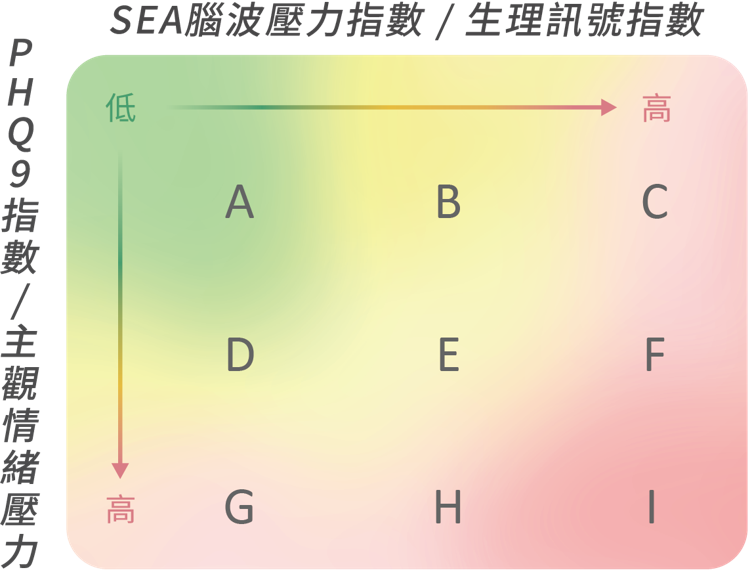
Patients may underreport symptoms due to stigma, low awareness, or difficulty expressing how they feel. The SEA Mind–Brain Matrix combines subjective responses with objective EEG indicators, helping clinicians open more meaningful conversations.

When physiological stress is high but self-perceived stress is low, clinicians can use the results to explain: "Your brain may already be showing signs of fatigue." This objective insight helps reduce defensiveness, make hidden stress more visible, and support better patient understanding.

Physio-Psychological Nine-Grid Matrix Illustration

Encouraging Deeper Dialogue

Helps patients discuss hidden or overlooked sources of stress.

Building Objective Awareness

Visualizes the gap between perceived stress and physiological signals to support treatment engagement.

Strengthening Physician–Patient Trust

Turns assessment results into a shared basis for communication and collaborative care.

Clinical Use of the SEA – Stress EEG Assessment

This video shares two clinical cases of physicians using the SEA – Stress EEG Assessment.

Young Patient Case

Explaining to Young Patient's Family

Although the patient possessed some insight into their condition, the family struggled to understand the nature of depression. Feeling helpless, they inadvertently placed additional pressure on the patient.


By presenting objective SEA EEG data, the physician demonstrated that depression is a neurobiological condition — not a matter of willpower.


This insight transformed the family’s dynamic from one of pressure to one of support, significantly reducing the patient's stress and accelerating their recovery.

Middle-aged Patient Case

Middle-aged Patient

Stigmatization and a lack of understanding led this patient to attribute their deep-seated depression to purely physical ailments. After experiencing multiple unsuccessful medical referrals, they were trapped in a cycle of seeking physical solutions for psychological pain.


Integrating the SEA EEG assessment proved instrumental; the objective data fostered immediate illness awareness. This clarity bridged the gap, leading the patient to embrace comprehensive psychiatric care and return to their normal life within six months.

Beyond assisting clinical diagnosis, objective EEG indicators transform the patient journey. By transforming abstract distress into clear evidence, they align the entire care circle — patients, families, and physicians — to foster treatment acceptance and secure superior clinical outcomes.

SEA EEG Stress Assessment System and Smiling Depression

Director Hsin-An Chang of Tri-Service General Hospital shares how objective assessment helps high-functioning smiling depression patients.

Clinical Use Case Sharing

Director Hsin-An Chang | Dept. of Psychiatry, Tri-Service General Hospital

Helping High-Functioning Patients Improve Awareness

Scenario Description

A female patient in her 40s with normal self-assessment mood scales, but accompanied by six months of insomnia and physical pain.

Clinical Observation

When assessed with the EEG stress evaluation system, the index was high (score of 9), showing a discrepancy with the patient's subjective perception.

Clinical Application

Using quantified data to improve the patient's illness awareness, the patient recognized that insomnia and physical pain were psychogenic, and successfully accepted treatment.

Clinical Pain Points

Patients seeking treatment for chronic sleep issues often overlook underlying depressive stress.

Unlike traditional scales, SEA quantifies physiological stress, avoiding the high costs and long wait times associated with neuroimaging or PSG exams.

SEA Index Application

Through the SEA – Stress EEG Assessment, a 15-minute assessment immediately reveals depression-related indicators.

Clinical Value

Differential Diagnosis: Distinguishes "pure physiological sleep apnea" from "psychogenic, stress-induced sleep disturbances".

Precision Treatment: Identifies stress-related sleep disorders, enabling targeted brain stimulation or medication intervention.

Alternative to Imaging: Provides diagnostic value comparable to major imaging without the associated costs or wait times.

Sleep Clinic | Far Eastern Memorial Hospital

90-Second EEG Screening: Breaking the Sleep-Stress Cycle

Yuan Rung Medical System

Building Intelligent Mental Health Screening,
Comprehensive Community Care

Yuan Rung Medical System Partnership

We partnered with Yuan Rung Medical System to integrate quantified EEG stress indicators with intelligent questionnaires, successfully deploying community-based services.

Through precise data, we assist healthcare professionals in providing enhanced and timely mental health interventions for both general health cases and post-COVID recovery patients.

SEA Value

Through EEG data, directly revealing hidden severe depression risks with scientific explanation.

Powerful Physician-Patient Communication: Convincing Logic-Oriented Patients

Logic-oriented patients typically resist traditional emotional diagnoses. Speaking with data — intuitive scores and visual charts — improves patients' illness awareness, significantly boosting treatment compliance.

Developing Sub-health Opportunities: Premium Self-pay Assessments

Providing innovative EEG assessments for sub-health cases such as post-holiday syndrome, attention deficit, and insomnia. Helping clinics establish professional differentiation and attract self-pay clients focused on mind-body balance.

Mental Health Clinic & Self-pay Application | Dr. Yang Tsung-Tsai | Director of Yang's Clinic

Quantifying EEG Data,
Making Invisible Psychological Stress 'Visible'
Dr. Yang Tsung-Tsai Article

From 'Nothing Really Wrong' to 'Feeling Much More Relaxed'

Filling the blind spots of subjective narratives, providing a more complete clinical perspective. In some cases, emotional or stress states may not be immediately recognized, or patients may not articulate them well.
Objective assessment tools help identify potential changes early, supporting more precise clinical interpretation.

Scenario Description

A middle-aged male patient with over 10 years of outpatient follow-up, usually self-reporting stable condition with a subjective feeling of 'nothing really wrong.'

Clinical Observation

When assessed with the EEG stress evaluation system, the index was relatively high (score of 9), showing a discrepancy with the patient's subjective perception.

Clinical Application

Considering the objective quantified data, the physician adjusted medication after in-depth communication with the patient.

Follow-up

After three months of reassessment, the SEA index improved significantly to 2, and the patient's subjective feedback was: 'Feeling much more relaxed.'

Outpatient Follow-up Illustration
Clinical Use of BDR – Brain Degeneration Risk Assessment

Dr. Lee Chia-Fu (Director, Dementia Collaborative Care Center, Taipei Tzu Chi Hospital).

Clinical Use of BDR – Brain Degeneration Risk Assessment

Identifying Hidden Causes: Distinguishing Late-life Depression from Dementia

Current Clinical Situation

Patients with late-life depression have twice the risk of developing dementia. Many elderly depressed patients are misidentified as having dementia (pseudodementia) due to declining memory and concentration, and traditional scales have difficulty clarifying the cause.

Application Value

Objective data assistance. Through EEG and AI algorithms, helping physicians quickly distinguish whether patients have depressive stress or mild cognitive impairment (MCI), avoiding over-treatment and seizing the golden intervention window.

Overcoming Assessment Distortion

Complementing Traditional Questionnaires and Imaging Limitations

Traditional cognitive scales are easily distorted by education level, hearing, or patient compliance; imaging exams (CT/MRI) are costly and require long scheduling.

Application Value

20-minute rapid measurement — EEG assessment is unaffected by the subject's educational background, providing real-time, non-invasive objective data as the basis for risk stratification and follow-up.

Precision Resource Allocation

Efficient Risk Tracking Management

Dementia collaborative care centers need to manage a large number of cases, making it difficult to conduct intensive monitoring for every patient.

Application Value

Risk stratification management. Classifying based on EEG assessment results — intensive monitoring for high-risk individuals, extended follow-up intervals for low-risk ones — improving healthcare resource allocation efficiency.